By Fay Shao, Founder and Director, SwahiliAfrika.
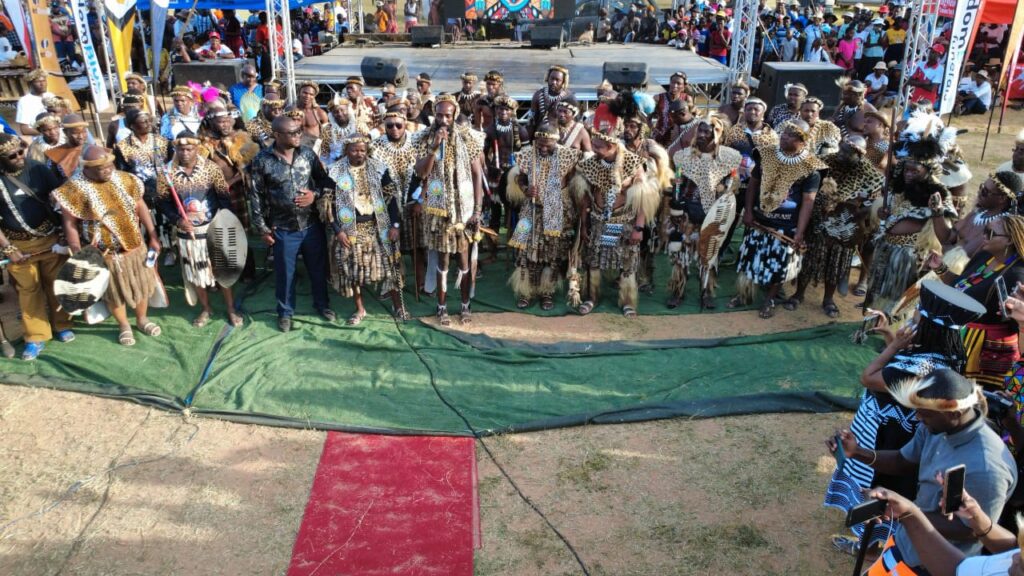
The SwahiliAfrika team recently had the privilege of attending a vibrant cultural celebration in Nkayi, Zimbabwe, where people from across Africa came together to experience the richness of Ndebele heritage. This event was a compelling testament to the power of unity in diversity showcasing the many cultural backgrounds that make our continent a wellspring of identity, creativity, and strength.
A Celebration of Unity
This cultural gathering underscored the importance of solidarity across cultures, highlighting the immense potential of cultural exchange to fuel economic cooperation and shared prosperity. As the late African scholar Ali Mazrui once noted, “Africanity is a complex and multifaceted concept that encompasses the cultural, linguistic, and historical diversity of the African continent” (Mazrui, 2010).
We applaud the chief’s visionary leadership in seizing opportunities for cultural advocacy, preservation, and packaging, which not only promoted Ndebele culture but also stimulated economic activities in the region.
We commend the visionary leadership of Chief Dakamela, whose unwavering commitment to cultural advocacy and preservation helped transform the event into a platform for empowerment. By promoting Ndebele culture and creating an inclusive space for dialogue and expression, the event stimulated both cultural pride and local economic activity.
The Language of Integration
While the event was a celebration of diversity, it also revealed the practical challenge of communication in a continent with hundreds of languages. With Ndebele, Shona, English, French, Portuguese, and Arabic spoken, the need for a common African language became evident. A shared language like Kiswahili can bridge these linguistic gaps helping to foster understanding, build trust, and drive forward the African integration agenda.
This experience demonstrates the need for a language that transcends ethnic and national boundaries, promoting unity and economic integration.
As philosopher Kwame Appiah noted, “Language is a fundamental aspect of human identity and culture” (Appiah, 2018). Beyond identity, language is also a vehicle for cooperation. The promotion of Kiswahili a language spoken by over 300 million people and recognized by global and regional institutions offers a meaningful way to unite Africans across borders.
Culture as an Economic Driver
The celebration went far beyond heritage appreciation it generated real economic value. Local entrepreneurs, artists, and small businesses benefited from increased visibility and market access. This validates economist Dambisa Moyo’s position that “Africa needs to rethink its reliance on aid and instead focus on trade and economic development” (Moyo, 2009).
Events like these show that cultural tourism can play a key role in job creation, SME growth, and the rejuvenation of rural economies. By integrating culture into broader development strategies, we can stimulate inclusive and sustainable economic growth.
A Common Language for a United Africa
A common language can play a vital role in advancing our vision of:
- African Continental Free Trade Area (AfCFTA): Facilitating trade and economic cooperation
- Inclusive Economic Transformation: Promoting economic growth and development for all Africans
- Liberation of Our Mindset: Fostering a sense of shared identity and purpose by sharing African values and discovering common ground
By embracing a common language, we can promote cultural exchange, build stronger communities, and advance African Renaissance. This can be achieved by:
- Sharing African Values: Communicating values like Ubuntu (Southern Africa), Ujamaa/Umoja (East Africa), and similar concepts like “Umunna” (Igbo, West Africa), which emphasize community, cooperation, and humanity. As Kwasi Wiredu argues, “African philosophy must be grounded in the cultural and historical context of the African people” (Wiredu, 2004).
- Discovering Common Ground: Realizing that these values are interconnected and shared across the continent, promoting a sense of unity and shared identity.
Benefits of a Common Language
A common language can help us:
- Promote Cultural Exchange: Share knowledge, traditions, and values across borders
- Build Stronger Communities: Foster a sense of belonging and cooperation among Africans
- Advance African Renaissance: Showcase the continent’s rich cultural heritage and promote a positive narrative
Advancing the Vision of Agenda 2063
This cultural celebration is well aligned with the African Union’s Agenda 2063, which envisions an integrated, prosperous, and peaceful Africa. It directly supports:
- Aspiration 1: A prosperous Africa based on inclusive growth and sustainable development
- Aspiration 5: An Africa with a strong cultural identity, common heritage, shared values, and ethics
- Economic Integration: AfCFTA promotes trade and economic cooperation among African countries, fostering economic growth and development
- Cultural Heritage: The event highlights the importance of preserving and promoting Africa’s rich cultural heritage
Recognizing Chief Dakamela’s Visionary Leadership
hief Mbusi Dakamela embodies a model of transformative and community-centered leadership that Africa urgently needs. He is a strong believer of ubuntu Philosophy His vision goes beyond cultural celebration it is a developmental blueprint rooted in local empowerment. Faced with structural limitations such as recurrent droughts and the absence of globally recognized natural wonders, Chief Dakamela has demonstrated that innovation and local agency can overcome environmental and economic constraints.
Rather than viewing Nkayi’s challenges as barriers, he leverages cultural capital as a catalyst for development. This vision aligns with Sen’s (1999) concept of development as freedom, which argues that expanding individuals’ capabilities particularly through cultural identity and community participation is fundamental to achieving sustainable development. By drawing on the local population’s existing assets, such as heritage knowledge, traditions, and social cohesion, Dakamela promotes inclusive economic growth from the bottom up.
Furthermore, Chief Dakamela’s approach reflects Elinor Ostrom’s (1990) theory of collective action, which highlights the effectiveness of community-managed resources and indigenous institutional arrangements. By mobilizing traditional leadership and communal networks, he has attracted support from government, private sector stakeholders, and even international interest, positioning Nkayi as a potential rural tourism hub.
This perspective is reinforced by Tomaselli and Shepperson (2002), who argue that cultural expression in African rural contexts is not merely performative but economically generative. Cultural events, when properly structured, can contribute to rural development, entrepreneurship, and self-sufficiency values central to Agenda 2063’s aspirations for grassroots transformation.
Chief Dakamela’s leadership serves as a continental example of how cultural heritage can be strategically deployed not only to preserve identity but also to stimulate livelihoods, local economies, and regional integration.
Recognizing Leadership: Chief Dakamela Achievers Awards
The Imiklomelo kaDakamela Awards, founded by Chief Dakamela, recognize and celebrate outstanding contributions to community development, culture, and innovation in Matabeleland North province. The 2025 edition, held on April 4–5 at koDakamela Hall in Nkayi, featured a community soccer tournament, musical gala, cultural exhibitions, and an awards ceremony honoring excellence across various sectors.
About Chief Dakamela
Chief Dakamela is a beacon of transformative leadership, known for promoting Ndebele culture and preserving the continent’s rich cultural heritage. His work continues to inspire cross-generational participation in Africa’s cultural rebirth.
About Swahili Afrika
Swahili Afrika advocates for Kiswahili as a common language to liberate and unite Africa. With over 300 million speakers globally, Kiswahili is spoken in more than 15 countries in Africa, making it the only African international language. Recognized by the United Nations, African Union, SADC, and EAC, Kiswahili serves as a powerful symbol and tool for Pan-African communication, liberation, and cooperation.
We believe that promoting Kiswahili as a common language can help break down barriers and promote greater understanding among Africans, driving economic integration and growth. Kiswahili is not only a language but a strategic resource one that can drive policy alignment, deepen trade ties under the African Continental Free Trade Area (AfCFTA), and foster a shared Pan-African identity.
Let’s Work Together
Let’s recognize the value of our cultural heritage and leverage it to build a brighter future for Africa. Swahili Afrika is proud to have participated in this remarkable event and commends Chief Dakamela’s efforts in promoting cultural advocacy and preservation. We look forward to collaborating with like-minded individuals and organizations to drive economic growth and unity across the continent.
Let’s celebrate our diversity. Let’s speak one language of unity. Let’s shape the future of Africa together.
Contact Information
Swahili Afrika
Website: www.swahiliafrika.africa Email: SwahiliAfrika@gmail.com Phone: +27 81 543 4514 Social Media: @SwahiliAfrika (Facebook, Twitter, Instagram, LinkedIn, TikTok)
Chief Dakamela’s Office
Contact Persons: Ntando Ndlovu kaSibasa & Kelly Ndlovu Phone: +263 774 788 370 & +263 777 020 799 Email: ntando@kbmagency.co.zw, ntandosibasa@gmail.com
References
- African Union Commission. (2015). Agenda 2063: The Africa We Want. Addis Ababa: African Union Commission.
- Wiredu, K. (2004). African Philosophy: An Introduction. University Press of America.
- Appiah, K. A. (2018). The Lies That Bind: Rethinking Identity. Liveright Publishing.
- Mazrui, A. A. (2010). The Africans: A Triple Heritage. BBC Publications.
- Moyo, D. (2009). Dead Aid: Why Aid Is Not Working and How There Is a Better Way for Africa. Farrar, Straus and Giroux.
- Ostrom, E. (1990). Governing the Commons: The Evolution of Institutions for Collective Action. Cambridge University Press.
- Sen, A. (1999). Development as Freedom. Oxford University Press.
- Tomaselli, K., & Shepperson, A. (2002). Media, Culture and Identity in South Africa. UNISA Press.
Recent Comments